


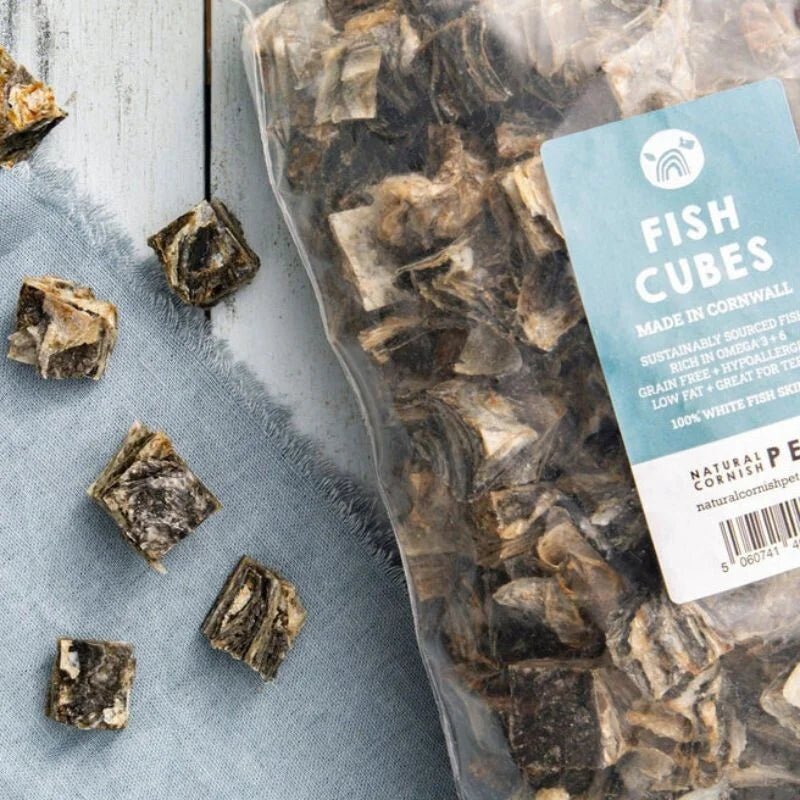
Whitefish is one of the most useful proteins in a dog's diet and one of the most underused. It sits in the shadow of salmon — which gets most of the press on omega-3 and coat health — but for many dogs, particularly those with sensitivities, whitefish does a job salmon cannot. It is leaner, milder, and easier to digest. For a dog that reacts to red meat, struggles with fat, or needs a novel protein for an elimination diet, whitefish is often the most practical starting point.
At The Pets Larder natural pet shop, we source our whitefish from Cornwall. That is not incidental to how we think about the product — it is the point. Knowing where a protein comes from, who caught it, and how it was handled between the water and the bag is part of the same ingredient standard we apply to everything we stock. Our Natural Cornish Dog Treats white fish cubes are a single-ingredient product: Cornish whitefish, dried, nothing else.
This post covers what whitefish actually does nutritionally, which dogs benefit most from it, how to read a fish treat label properly, and why sourcing matters in a category where it is rarely discussed.
What is whitefish and why does it matter for dogs?
Whitefish is a broad category covering lean, white-fleshed sea fish — cod, haddock, coley, pollock, whiting, and similar species. What they share is a nutritional profile distinctly different from oily fish like salmon or mackerel: lower in fat, higher in lean protein per calorie, and milder in flavour and smell. That last point matters more than it sounds — a dog in training needs a treat that holds attention, not one so pungent it overwhelms a working environment.
From a nutritional standpoint, whitefish offers high-quality complete protein — all essential amino acids present in good ratios — alongside meaningful levels of B vitamins, phosphorus, selenium, and iodine. The omega-3 content is lower than oily fish but still present, contributing to coat condition and inflammatory modulation. For dogs that cannot tolerate the fat load of salmon-based treats, particularly those managing weight or prone to pancreatitis, whitefish delivers the protein and micronutrient benefit without the fat consequence.
The lean profile also makes whitefish one of the few natural treats genuinely suitable for high-frequency training use. A dog in a reward-based training session may receive thirty to fifty treats over forty minutes. The cumulative fat and calorie load of most natural treats makes that volume impractical. A small whitefish cube — high protein, low fat, highly palatable — can be fed at that frequency without disrupting a weight management plan or causing digestive upset.
Which dogs benefit most from whitefish?
Dogs with food sensitivities or confirmed allergies are the most obvious beneficiaries, but the case for whitefish is broader than that.
For dogs on elimination diets investigating a suspected food allergy, whitefish offers a genuinely novel protein for the majority of dogs that have been fed chicken, beef, or lamb-based diets their entire lives. An elimination diet requires a protein the dog has never encountered — and while novel proteins like venison or kangaroo are well-documented, whitefish is frequently overlooked despite being equally effective and considerably more available. A single-ingredient white fish treat used during an eight-to-twelve-week elimination trial does not compromise the diagnostic process.
For dogs managing their weight, the lean profile of whitefish means a meaningful treat can be given without a meaningful calorie penalty. A small dried whitefish cube delivers palatability, reward value, and protein without the fat content that makes richer natural treats impractical in calorie-controlled diets. Our low fat dog treats post covers the full picture for dogs where calorie management is a priority.
For dogs with pancreatitis or a history of fat sensitivity, the low fat content of whitefish treats makes them one of the safest natural reward options available. Most natural treats — ears, bully sticks, liver — carry fat loads that require careful management in fat-sensitive dogs. Whitefish does not.
For senior dogs with reduced kidney function, the lean protein in whitefish provides nutritional value with lower phosphorus relative to red meat proteins — relevant in dogs where phosphorus management is part of dietary care. Always check with your vet if your dog has a diagnosed kidney condition before making significant dietary changes.
How to read a fish treat label
Fish treats are a category where ingredient transparency is particularly inconsistent. The label tells you what you are actually buying if you know what to look for.
A single-ingredient fish treat should list one thing: the fish, and the species. "Dried cod" or "whitefish (pollock), dried" is correct. "Fish" with no species identified is not — you have no information about what fish, where from, or in what condition it was when processed. "Fish and fish derivatives" is the worst formulation: an unnamed, unspecified protein source that could include any species, any part, any quality grade.
Check for added preservatives. Dried fish treated with natural preservation methods — low moisture, air-drying — does not need artificial preservatives to achieve a safe shelf life. If a fish treat lists BHA, BHT, or ethoxyquin, those additives are doing work that proper drying and packaging should make unnecessary. Their presence in a fish treat is a signal about processing quality, not just ingredient quality.
Check the guaranteed analysis for crude fat. For dogs where fat content matters — weight management, pancreatitis history, fat sensitivity — the crude fat percentage on the label tells you what you are actually feeding. Genuine lean whitefish treats should show low crude fat. If you want to score any treat label before buying, the Decode Your Label tool does it in seconds.
Why Cornish sourcing matters
Cornwall has one of the most active inshore fishing fleets in the UK. Day boats working out of Newlyn, Looe, and Mevagissey land whitefish caught within hours of the port — a supply chain short enough that traceability is practical rather than theoretical.
For pet food, fish sourcing is rarely discussed with the specificity it receives in human food. Most dried fish treats on the UK market carry no country of origin beyond "Atlantic" or simply omit sourcing information entirely. That is a transparency gap that matters. Fish quality degrades quickly after catch, and the nutritional value of a dried fish treat is directly tied to the quality of the fish at the point of processing.
Sourcing locally from Cornwall gives us two things. First, genuinely short supply chain — we know where the fish came from and can verify it. Second, the ability to use fish that meets a fresh standard rather than a processed input standard. The white fish cubes are made from fish we would be comfortable describing in full, because we can. You can read more about how The Pets Larder started and what drives our sourcing decisions in the natural pet shop story.
Using white fish treats in training
The practical attributes of white fish treats for training work are worth being specific about.
Size: effective training treats should be small enough to be consumed in under three seconds so the dog refocuses immediately. Our white fish cubes are sized for this — small enough for rapid reward delivery without the dog losing attention to extended chewing.
Smell: dogs work partly on olfaction in training. A treat that smells strongly of fish holds attention reliably, including in environments with competing distractions — outdoor training, group classes, recall work in the field. Whitefish has a distinctive smell without the overpowering intensity of liver or sprats, making it practical indoors as well as outside.
Digestibility: high-frequency treat delivery over a training session means the digestive system is processing a meaningful cumulative quantity. A treat that is difficult to digest or high in fat will cause problems at volume. Whitefish is among the most digestible natural proteins available.
Allergen control: for dogs on managed diets or in the middle of an elimination trial, having a treat that is confirmed single-ingredient and novel-protein means training does not need to pause during a dietary investigation.
You can find our white fish cubes and the full Natural Cornish Dog Treats range on the site. If you are not sure which protein suits your dog's specific health situation, the Food Recommender takes you through the relevant variables.
The honest answer on fish treats
Not all fish treats are equal and the label is the only reliable guide. Named species, declared source, single ingredient or short ingredient list, no artificial preservatives — those are the criteria. A treat labelled "fish" with no further detail, regardless of how it is positioned on the front of the pack, is not giving you the information you need to make an informed decision.
Whitefish specifically — as opposed to fish generally — is one of the most practical proteins for dogs with sensitivities, dogs managing their weight, dogs in training, and dogs whose owners want a treat they can use in volume without dietary consequence. It is not glamorous. It does not carry the same health associations as salmon. But for the dogs and the situations where it fits, it is difficult to improve on.
We make ours from Cornish whitefish because that is the standard we applied to our own dogs first. If you have a question about whether it suits your dog's specific situation, contact us directly. Fifteen years of professional animal care gives us enough context to give you a straight answer rather than a product recommendation.