



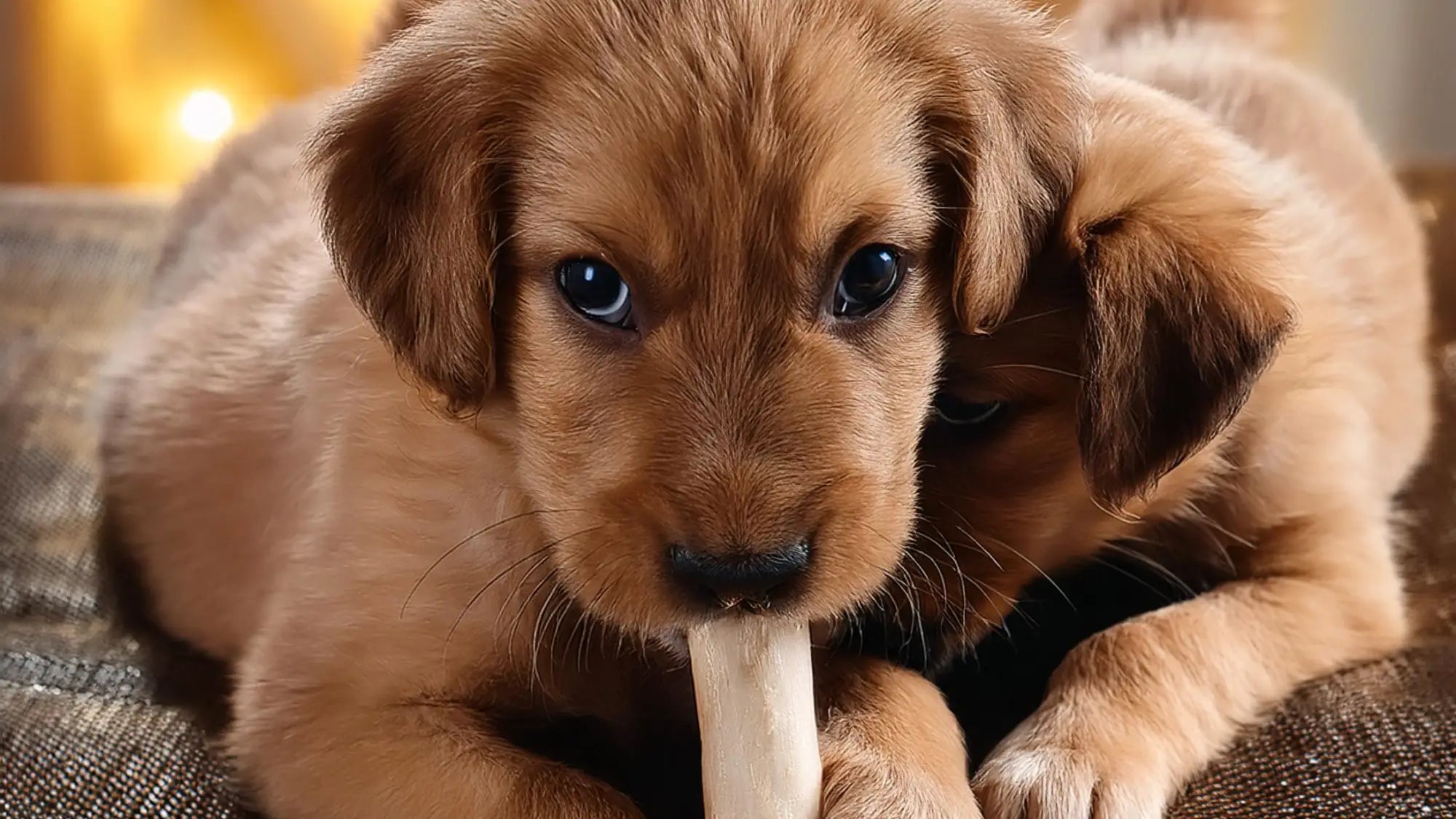
Puppies chew. It is not a behaviour problem — it is how they explore, how they manage teething discomfort, and how they begin to develop the jaw strength and dental hygiene habits that carry through into adult life. The question is not whether to give a puppy something to chew on, but what.
The wrong chew at the wrong stage does real damage. A chew that is too hard for deciduous teeth causes fractures. A chew that breaks into large swallowable chunks is an obstruction risk. A chew with artificial additives or excessive fat puts unnecessary pressure on a digestive system that is still developing.
This guide covers what to look for at each stage, five options we stock at The Pets Larder that we are confident recommending for puppies, and a straightforward framework for matching the right chew to your puppy's age and chew strength.
For the full range, the natural puppy chews collection has everything we stock filtered to puppy-appropriate options.
What puppy chewing is actually for
There are three distinct phases of puppy chewing, each with different requirements:
Teething (approximately 3–6 months): Deciduous teeth are coming through, gums are sore, and the puppy needs relief. Chews at this stage should be soft enough not to fracture baby teeth — the thumbnail test is a reasonable guide: if you cannot make an indent in the chew with your thumbnail, it is probably too hard for a teething puppy.
Post-teething, adult teeth coming in (approximately 6–9 months): Adult teeth are more robust but the jaw is still developing. Moderate hardness is appropriate. This is when you can start introducing longer-duration chews, but anything designed for a strong adult chewer is still too hard.
Juvenile to adult (9 months+): Depends entirely on breed, size, and chew drive. A nine-month Labrador and a nine-month Chihuahua have completely different chew requirements. Hardness, size, and duration should all scale with the individual dog rather than age alone.
What to look for on a puppy chew label
Protein source named: "Duck neck" or "lamb braid" tells you something. "Meat and animal derivatives" tells you almost nothing.
Ingredient list length: The shorter, the better. A single-ingredient chew has nothing to hide. A long ingredient list on a chew is worth scrutinising.
No artificial preservatives, colours or flavours: These are unnecessary in a chew and have no nutritional role. Their presence is a marker of a product that is more about shelf life and palatability engineering than ingredient quality.
Appropriate hardness for age: This is the most commonly ignored variable. Many chews marketed at puppies are still too hard for teething-stage teeth. Check reviews from owners of similar-age dogs, or ask us directly.
Five puppy chews we stock and recommend
Green & Wilds Puppy Antler Chew
Antlers are among the longest-lasting natural chews available — but standard antlers are too hard for puppies and carry a real tooth fracture risk. Green & Wilds solve this with a puppy-specific antler that is naturally softer than full adult antler, sourced from naturally shed antlers rather than culled animals.
The mineral content is the nutritional case for antlers: calcium, phosphorus, zinc, and manganese, all relevant for skeletal development in a growing dog. The marrow is accessible without the dog having to work through solid bone, which makes it more rewarding for a puppy that does not yet have the jaw strength for a full antler.
Sustainably sourced, single ingredient, no processing beyond cleaning and cutting. The appropriate size matters — choose based on your puppy's weight, not just age, and size up before you think you need to.
Best for: Puppies from approximately 12 weeks, moderate chewers, owners who want duration from a clean single-ingredient chew.
The Pets Larder Vegetable Chews — Peanut Butter Turtles
Our own vegetable chews are produced to our recipe in a high-welfare factory and are among the lowest-calorie chew options we stock. The peanut butter turtle format is particularly useful for puppies: the shape provides grip for a small jaw, the vegetable base is soft enough for developing teeth, and peanut butter palatability means most puppies engage with them readily even if they are not yet confident with chew formats.
Vegetable chews do not provide the same mechanical dental benefit as protein-based chews of similar hardness — they are softer, they break down faster, and the abrasion is limited. What they do provide is safe chewing engagement with minimal calorie load, which is useful for puppies where the goal is habit-building and enrichment rather than extended duration.
They are also a useful option for puppies that are yet to have their full vaccination course and whose owners want to avoid animal protein chews from unknown provenance until they know more about the puppy's sensitivities.
Best for: Teething puppies, very young dogs, puppies with uncertain protein tolerances, light chewers, enrichment use where duration is less important than engagement.
JR Pet Products Braided Lamb Braid
JR Pet Products is a Welsh producer whose single-ingredient chews are made from named, traceable protein sources with no additives. The braided lamb is made from lamb skin, dried and braided — a medium-hardness chew that provides meaningful duration without being too demanding for a puppy jaw.
The braided format has a practical advantage: the texture and structure means the puppy has to work along the chew rather than attempting to break off large chunks, which reduces the risk of the choking-hazard scenario that comes with some chews that snap rather than fray. It frays as it is chewed, which makes it safer to monitor and easier to take away at the point it becomes a swallowable piece.
Lamb skin is a relatively novel protein for most puppies, which is useful if you want to preserve common proteins — chicken, beef — as diagnostic tools if you ever need to run an elimination diet.
Best for: Puppies from approximately 12 weeks, moderate chewers, owners who want a medium-duration protein chew with a clean label, and those who want to introduce a novel protein early.
Earth Animal No-Hide Stix
Earth Animal No-Hide Stix are the puppy-appropriate format of the No-Hide range — smaller, thinner, and designed for dogs that are not yet ready for the full-size version. The same digestible protein base applies: chicken, salmon, or venison formed into a chew without the obstruction risk of rawhide.
For puppy owners who are looking for a rawhide-format chew — the shape, the chew duration, the reward that comes from working through something — No-Hide Stix are the most credible option in that category for younger dogs. Rawhide itself is not appropriate for puppies at any stage: the chemical treatment, the swelling when wet, and the obstruction risk are all amplified in a dog with a smaller digestive tract and a still-developing gut.
The ingredient list is longer than a single-ingredient chew, which is worth noting. But the digestibility and safety profile is well-evidenced and the format is genuinely useful.
Best for: Puppies from approximately 12 weeks, moderate chewers, owners transitioning away from rawhide or looking for a medium-duration chew with good digestibility.
Side-by-side comparison
| Green & Wilds Puppy Antler | TPL Vegetable Turtle | JR Lamb Braid | No-Hide Stix | |
|---|---|---|---|---|
| Protein source | Single ingredient (antler) | Vegetable / peanut butter | Single ingredient (lamb) | Chicken / salmon / venison |
| Hardness | Medium | Soft | Medium | Medium–soft |
| Chew duration | Long | Short–medium | Medium | Medium |
| Minimum age | 12 weeks | 8 weeks | 12 weeks | 12 weeks |
| Grain-free | Yes | Yes | Yes | Yes |
| Best use | Duration, minerals | Enrichment, teething | Novel protein, moderate duration | Rawhide alternative |
How to introduce chews safely
One at a time: Introduce a new chew type on its own, not alongside a food change or another new treat. If your puppy has a digestive reaction, you want to know what caused it.
Supervise initially: Watch how your puppy approaches a new chew — whether they try to bite off chunks, how quickly they work through it, whether they are showing frustration or distress. A puppy that is trying to swallow large pieces needs either a different chew or closer management.
Remove before it becomes a risk: Any chew that has been reduced to a size your puppy could swallow whole should be taken away. For most chews, that is when it is roughly the size of a golf ball or smaller. The microwaveable end-piece trick applies to Yakers for adult dogs; for puppies, simply remove it.
Size up, not down: When in doubt about size, go larger rather than smaller. A chew that is too big for a puppy to make progress on is frustrating but safe. A chew that is too small is an obstruction risk.
What to avoid
Standard rawhide: Not appropriate for puppies at any stage. The chemical processing, swelling risk, and obstruction potential are all amplified in a young dog.
Full adult antlers: Too hard for deciduous teeth. Stick to the puppy-specific or junior versions until adult teeth are established.
Very hard protein chews: Bully sticks are fine for many puppies; hooves, hard bones, and very dense chews designed for strong adult chewers are not.
Any chew the puppy tries to eat whole: A puppy that is treating a chew as a food item rather than a chewing object is telling you the size is wrong or the chew is too soft for their drive.
Browse puppy chews
The options above are a selection of what we stock. The natural puppy chews collection has the full range, with notes on each product to help you match by age and chew strength. If you are unsure, contact us directly — we would rather help you get it right than have you guess.
Written by Katy Peck, founder of The Pets Larder. Katy founded Doggy Day Care Cornwall in 2014, scaling it to a daily capacity of 80 dogs before opening The Pets Larder in 2018. The Pets Larder won Independent Pet Shop of the Year (PetQuip & PIF) in 2021.


