


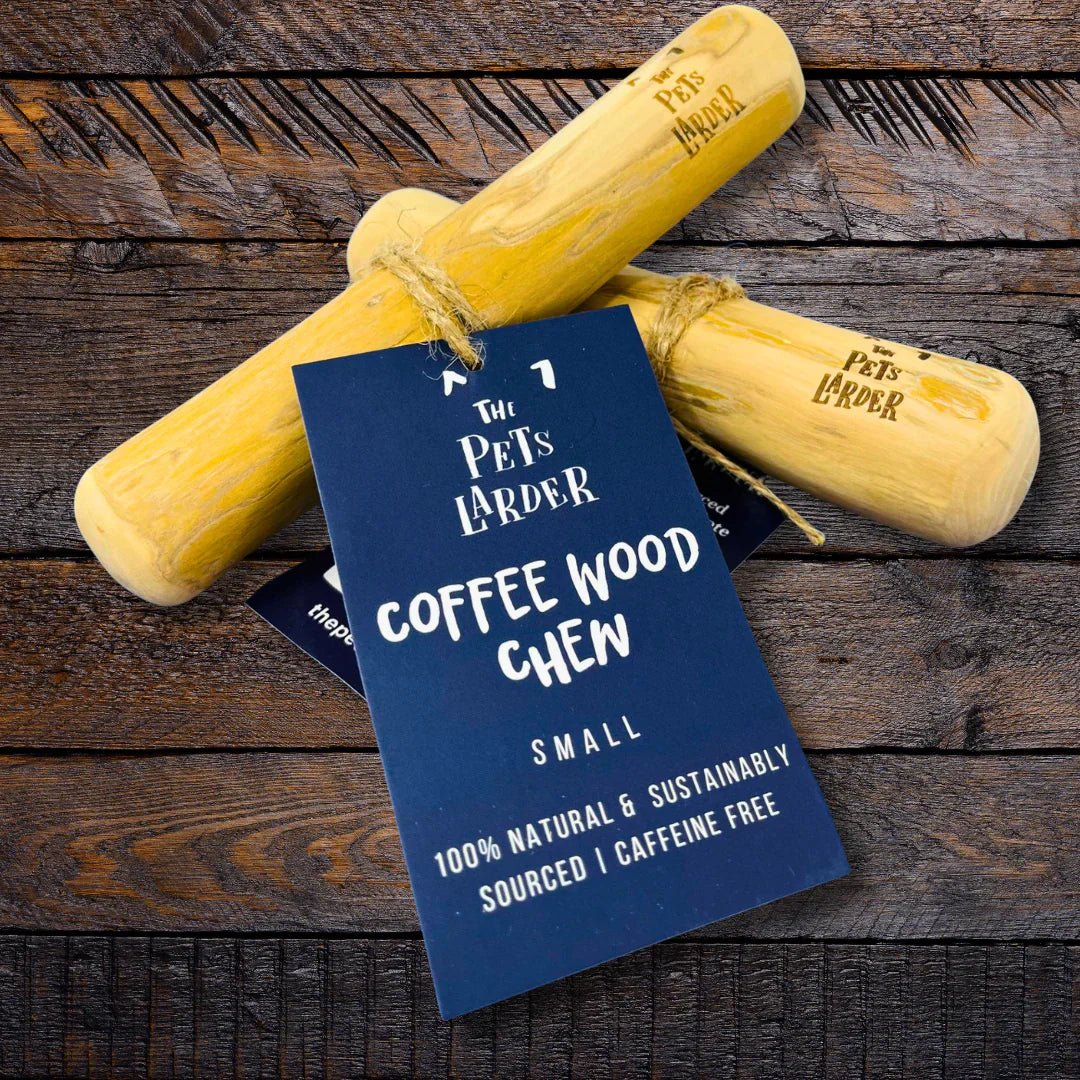
Coffee wood chews sit in a specific part of the natural chew market — the part designed for dogs that destroy everything else. They are not for every dog. They are for the dog that goes through a bully stick in fifteen minutes, collapses a rubber toy inside a week, and has a history of reducing natural chews to splinters before the owner has finished their coffee.
For those dogs, coffee wood is one of the most practical options available. It is genuinely long-lasting, non-toxic, and provides the sustained mechanical chewing that strong chewers need for their physical and psychological wellbeing. This post covers what coffee wood actually is, how it works as a chew, which dogs it suits, and what the limitations are. For a broader guide to rawhide alternatives, the alternatives hub covers the full natural chew category.
What is coffee wood?
Coffee wood chews are made from the branches and trunks of coffee trees (Coffea arabica or related species), which are harvested at the end of their fruit-bearing cycle — typically after fifteen to twenty years of production. The wood is cut, cleaned, dried, and shaped into chew-appropriate sizes. No chemicals are added, no treatment is applied, and no adhesives or synthetic materials are used.
The coffee plant produces an extremely dense, hard wood. The density is a function of the plant's growth pattern — slow growth over many years produces tight grain and high hardness. This is what makes coffee wood suitable for very strong chewers when softer materials are not. It is harder than most natural wood chews and significantly harder than any dried meat chew.
The wood contains no caffeine in amounts that would affect dogs. Caffeine is concentrated in the coffee bean and the green leaves — the mature wood itself contains negligible levels. This is a common question when owners first encounter the product, and the answer is that the chew does not carry the same caffeine risk as the coffee in your cup.
The agricultural source matters: coffee trees at end-of-life are otherwise a waste product from coffee farming. Using them for dog chews is a practical use of material that would otherwise be composted or burned, which is one of the reasons coffee wood chews have a reasonably clean sustainability story compared to most other long-lasting chew options.
How coffee wood works as a chew
Coffee wood is a non-consumable chew. The distinction is important: unlike a bully stick, ostrich bone, or ear, which the dog works through and eventually finishes, coffee wood splinters off in very small fibrous pieces as the dog chews. Those fibres are safe to swallow in the quantities produced — they are soft, fine, and digestible — but the main body of the chew does not diminish at the same rate as a digestible protein-based chew.
The result is a chew that lasts considerably longer than any protein chew for a strong chewer. A bully stick that a large Staffie finishes in twenty minutes might last the same dog two hours on a coffee wood chew of comparable size. For owners trying to give a high-energy or anxious dog a sustained occupier, the duration difference is significant.
The mechanical action of chewing on coffee wood provides dental benefit through abrasion — the wood's hardness means the dog has to work to chew it, and that sustained abrasive contact helps remove surface plaque. This is covered in more detail in the natural dental chews post, which explains what natural approaches to dental health actually achieve.
The chew also produces a faint coffee aroma that many dogs find appealing — it increases self-directed engagement with the chew rather than requiring the owner to make it interesting.
Which dogs are coffee wood chews right for?
The primary target is the strong, persistent chewer that destroys conventional natural chews too quickly for them to serve their occupational purpose. Large breeds — Labradors, Rottweilers, German Shepherds, Staffies, Huskies — frequently fall into this category. But chew strength is individual rather than breed-specific: some medium-sized dogs are very strong chewers and some large dogs are gentle.
The useful self-test: if your dog works through a bully stick in under twenty minutes, a coffee wood chew is likely to be a better investment in terms of duration. If your dog is a moderate chewer who takes forty minutes to an hour on a standard natural chew, coffee wood may not be necessary — other options from the natural chews collection will serve just as well.
Coffee wood is not appropriate for puppies under six months, whose deciduous teeth are not strong enough for the hardness of the material. It is not appropriate for senior dogs with dental disease or worn teeth — the hardness that makes it valuable for young, strong chewers can cause tooth fracture in a dog whose dental health is compromised.
The hard-surface test applies here as it does for all hard chews: press your thumbnail firmly into the chew surface. If you cannot leave a mark, the chew is too hard for any dog with existing dental concerns.
Sizes and supervision
Coffee wood chews come in various sizes corresponding broadly to dog size. Selecting the right size matters: a chew that is too small for a large dog can become a choking hazard as it diminishes. The general principle is to select a chew large enough that the dog cannot get it fully into the back of its mouth in a way that risks swallowing the whole piece.
Supervision is recommended for any chew, and particularly for a dog encountering coffee wood for the first time. Most dogs chew it appropriately — working at the end of the stick and producing fine fibres — but dogs unfamiliar with the texture occasionally try to break off larger pieces rather than working the surface. Monitor the first few sessions to ensure the chewing style is correct.
Remove and replace the chew when it has diminished to a size that fits comfortably in the dog's mouth whole. As with any chew, the piece that cannot be swallowed safely is the piece that creates risk.
We stock coffee wood chews in sizes appropriate for small-to-medium and medium-to-large dogs. If you want to check whether it is the right product for your dog's specific chewing needs and profile, the Chew Finder on the site will take you through the relevant variables.
Coffee wood in the context of a natural chew rotation
The most effective approach to providing for a strong chewer's needs is not a single product but a rotation of chew types that address different needs. Coffee wood provides duration and dental abrasion. A bully stick or pizzle provides protein and dietary contribution. A softer chew like a tendon or ear provides a different texture and sensory experience that rounds out the chewing repertoire.
For owners managing a dog with significant chewing drive, separation anxiety, or a history of destructive behaviour, a structured chew rotation — different types on different days, appropriate to the dog's energy level and context — provides more complete behavioural support than a single chew type delivered repeatedly. Contact us if you want help building a chew rotation that suits your specific dog's needs.