



A real-world guide to ratios, not absolutes
I'll start with the line that matters most: dogs are not cake eaters.
Their bowls should not be primarily grain. They evolved on meat, organs, bone, and small amounts of plant matter — usually in the form of partially digested vegetables and grains found in the stomachs of their prey. That's the proper context for any conversation about grain-free feeding. It's not about whether grains are evil; it's about ratios. As humans we already know that eating too much cake or bread causes digestive discomfort. Dogs are just the same.
Once you frame it that way, the question changes. It stops being "should I feed grain-free?" and becomes "is grain the right proportion of my dog's diet?" A bowl that's predominantly grain is wrong for dogs. A bowl that's predominantly meat with modest, varied carbohydrate sources — including, for some dogs, a little grain — can be entirely right.
What I'm bringing to this is twelve years of watching dogs digest. Four years running Doggy Day Care Cornwall observing up to 80 dogs a day across every conceivable feeding regime. Eight years running The Pets Larder, hearing from thousands of owners about what changed when they switched. The most consistent indicator of whether a food is working has always been, quite literally, what comes out the other end. Stool quality reflects digestion, gut health, allergic load, hydration, and protein efficiency in a single observable output.
So this is a real-world guide to the best grain-free dog food in the UK for 2026 — what I've actually seen across twelve years, framed by the principle that ratios matter more than absolutes. If you're searching for grain-free dog food that genuinely works — high-meat, properly formulated, free of legume bulking, and trusted by dog owners who care about quality — this guide has the brands I'd recommend and the reasoning behind each one.
At a Glance: The Brands We Recommend
If you want the short version before the depth, here are the five grain-free dog foods I'd put my own dogs on:
- Canagan — the benchmark for grain-free done properly. First-time transitions, dogs with skin or ear issues.
- Aflora — our own brand, the same philosophy as Canagan at a more accessible price.
- Tribal Cold-Pressed — gentle on sensitive stomachs, ideal for dogs with digestive issues.
- Lily's Kitchen Grain Free — wet feeding for older or fussy dogs.
- Forthglade Grain Free — accessible mid-tier wet, a sensible introduction to grain-free.
If you want to understand why these brands and not others — what twelve years of watching dogs digest taught me, what the DCM evidence actually says, and why ratios matter more than ideology — read on.
The Lesson Louis Taught Me
A few years ago I switched my cat Louis to a raw diet, due to an ongoing issue with cystitis. Within a few months his beautiful black coat developed a tinge of red. I researched it carefully and traced the change back to what was missing from his new diet. In the wild, cats consume a small amount of plant matter and stomach contents from the prey they eat — partially digested grains, vegetable matter, and trace micronutrients that contribute to nutritional balance in ways simplified diets sometimes miss. By feeding pure raw meat without those trace components, I'd inadvertently removed something the diet genuinely needed for proper coat pigmentation and condition.
I tell that story not to argue for grain in dog food, but to make a point about how I think about feeding generally. Even the right answer needs nuance. Going completely grain-free works for many dogs — particularly those with confirmed sensitivities. But thinking in absolutes ("grains are bad", "raw is best", "kibble is poison") is how owners end up with subtly wrong outcomes that take time to notice.
The principle that emerged for me from Louis: feed in proportions that reflect what the animal evolved on. For dogs, that means meat-led, varied vegetables, modest carbohydrate. If grain appears at all, it should be in the small ratio — never as the bowl's primary ingredient. A morsel of toast as a treat? Fine. A grain-rich kibble as the everyday diet? That's where dogs run into trouble.
The DCM Question: What the Evidence Actually Says
Any honest blog on grain-free has to address the DCM controversy, so let me do that properly.
In July 2018, the US FDA announced an investigation into a possible link between grain-free diets and dilated cardiomyopathy (DCM), a serious heart condition in dogs. The announcement caused immediate consumer panic-switching back to grain-inclusive brands. Major news coverage followed. Independent grain-free brands — many of them small, family-run UK and US companies that had been growing rapidly through the 2010s — saw sales fall substantially. Some closed; others pivoted to add grain-inclusive lines.
It's worth noting the timing. Grain-free had been the fastest-growing category in pet food through the mid-2010s. The FDA announcement also arrived during a period when grain-free feeding was rapidly growing in popularity and disrupting established areas of the pet food market.
It's also worth noting how the investigation was prompted. A 2022 investigation by Buzzfeed News established that the veterinarians who first urged the FDA to look into grain-free diets had financial ties to leading sellers of grain-inclusive pet foods. That's not allegation — it's documented. Whether that influenced the speed or framing of the FDA announcement is impossible to know. But it's part of the honest context.
What the evidence has actually shown since the FDA investigation began:
- The FDA has been unable to establish causation despite years of investigation
- The most recent FDA position (December 2022) was a quiet update appended to a three-year-old press release, stating that the reports "do not supply sufficient data to establish a causal relationship"
- Reports surged immediately after the 2018 announcement and have since fallen sharply — a known phenomenon in pharmacovigilance where publicising a suspected link dramatically increases reporting of that link
- Both grain-free and grain-containing diets appeared in the reports
- The strongest pattern, where one exists, is with legume-heavy formulations (peas, lentils, potatoes high in the ingredient list) — not grain-free per se
- Reports include kibble, canned, raw, and home-cooked diets — though the overwhelming majority involved commercial kibble
What the evidence doesn't yet establish:
- That grain-free diets cause DCM
- That removing grain-free from the market would reduce DCM incidence
- Which specific compounds or formulation choices are responsible, if any
The UK context:
The UK regulatory perspective has been notably less alarmist than the US. Many UK natural pet food brands had already moved away from heavy legume reliance before the FDA investigation. Reformulation across the industry since 2018-2019 has been substantial.
My practical takeaway:
The DCM scare doesn't justify avoiding grain-free. It does justify avoiding legume-heavy formulations — recipes where peas, pea protein, lentils, or potato dominate the first five ingredients. That's a real signal the FDA data points toward, regardless of how you read the politics around the original announcement. The brands I recommend below all meet this standard — meat-led recipes with varied vegetables rather than legume-bulked formulations.
If your dog has any underlying cardiac concern, discuss diet with your vet before committing to any specific formulation, grain-free or otherwise.
The DCM concern is a useful filter, not a blanket warning against grain-free. It points you toward better-formulated grain-free foods rather than away from grain-free entirely.
Who Genuinely Benefits from Grain-Free?
In my twelve years of observation, the dogs that genuinely benefit from going grain-free fall into clear categories.
Dogs with confirmed grain sensitivities
Wheat, maize, and barley can be problem ingredients for some sensitive dogs. The clinical picture is recognisable: persistently itchy skin, recurring ear infections (often yeast-driven), greasy coat, occasional loose stools, sometimes hot spots. Move to a properly formulated grain-free food and within 6-8 weeks you typically see substantial improvement across all those markers.
Dogs with dry, flaky coats and persistent dandruff
Sometimes the issue isn't a true allergy but sensitivity to grain volume. A grain-free formulation with higher meat content and varied vegetables often resolves coat issues that wheat-heavy kibble couldn't.
Dogs with chronic loose stools on grain-inclusive food
Not always grain-related — could be protein source, fat content, a hundred other variables — but if you've tried multiple grain-inclusive foods without firming up stools, grain-free is a reasonable next step.
Dogs prone to recurring ear infections
Ears are often the first site to show grain sensitivity. Yeast loves the inflammatory environment that grain-allergic dogs produce. Switching to grain-free is one of the most reliable interventions I've watched for chronic ear-prone dogs.
Dogs whose owners want to feed in proportions closer to evolutionary diet
Some owners simply prefer a meat-led, varied-vegetable approach without grain — on principle rather than to solve a problem. That's a legitimate position. Properly formulated grain-free is genuinely high-quality feeding, not a compromise.
The honest position on grain-inclusive feeding:
For dogs without skin, ear, coat, or digestive issues — and where the grain-inclusive food is properly formulated with meat as the primary ingredient and grain in modest, appropriate ratio — there's nothing wrong with feeding grain-inclusive. The problem isn't grain itself. The problem is grain being the dominant component of the bowl.
A quality grain-inclusive food where meat content is 50%+ and grains appear as a smaller, varied carbohydrate source is fine for most dogs. Most premium dog foods sold in the UK either avoid grains entirely or use them in modest ratios. The foods I'd avoid are ones where wheat, maize, or rice are in the first three ingredients, with vague meat references later down. Those are the cake-eater bowls.
The Poo-Scoring Lens on Grain-Free
Quality grain-free feeding produces excellent stools when matched to the right dog. Across the brands I'd recommend below, the typical result for a suitable dog:
- 9-10/10: Firm, well-formed, easy to scoop, minimal odour. What you'd hope for.
- 8/10: Generally good, occasional softer end. Most healthy dogs settle here on a working food.
- 6-7/10 or below: Either wrong formulation for the dog (often too high in legumes or fat), wrong protein, or the dog doesn't actually need grain-free.
Grain-free foods that produce poor stool quality almost always have one of three issues: legume-heavy formulation that's hard to digest, fat content too high for the dog's energy demands, or a protein the dog doesn't tolerate. Switching brand or recipe within grain-free usually solves it.
Grain-Free Doesn't Automatically Mean Meat-Rich
One of the biggest misconceptions in pet nutrition is assuming grain-free automatically means low-carbohydrate or meat-rich. Some grain-free foods simply replace wheat with peas, lentils, or potato starch in equally excessive proportions. Removing grain alone doesn't improve a diet if the carbohydrate load remains dominant — it just changes the source.
This is why reading the ingredient list matters more than reading the front of the bag. A food labelled "grain-free" with pea protein, pea fibre, and potato starch in the first five ingredients is not biologically more appropriate than a quality grain-inclusive food with named meat as the primary ingredient. The marketing has done its job. The bowl hasn't changed.
The brands I recommend below all earn the grain-free label by replacing grain with high meat content and varied vegetables — not by replacing grain with concentrated legume bulking.
The Best Grain-Free Dog Foods We Stock
These are the brands I'd recommend, with honest notes on where each one fits.
Canagan
The benchmark for grain-free done properly.
Canagan has been the brand I've watched produce the most consistent stool quality across grain-free feeding for years. Their 60/40 formulation (60% meat, 40% vegetables and botanicals) is, in my direct observation, the closest dry food has ever come to producing raw-quality digestion. Named meat sources lead the ingredient list. The vegetable content is varied — sweet potato, carrots, spinach, parsley, marigold, modest pea content rather than dominance. If you're moving a dog to grain-free for the first time and want the highest probability of success, Canagan is what I'd start with.
Key Benefits:
- Around 60% meat content (varies by recipe)
- 100% grain-free for easy digestion
- EU-made, with high welfare meat sourcing
- Joint support included as standard (glucosamine, MSM, chondroitin)
- Available in dry and wet formats
- Net-zero carbon manufacturing
- Stool quality consistently 9-10/10 in suitable dogs
Best For: First-time grain-free transitions, dogs with skin or ear issues, owners who want the closest thing to raw-quality digestion in dry form.
One caveat: like any rich meat-led food, some lower-energy dogs may need careful portion control during transition.
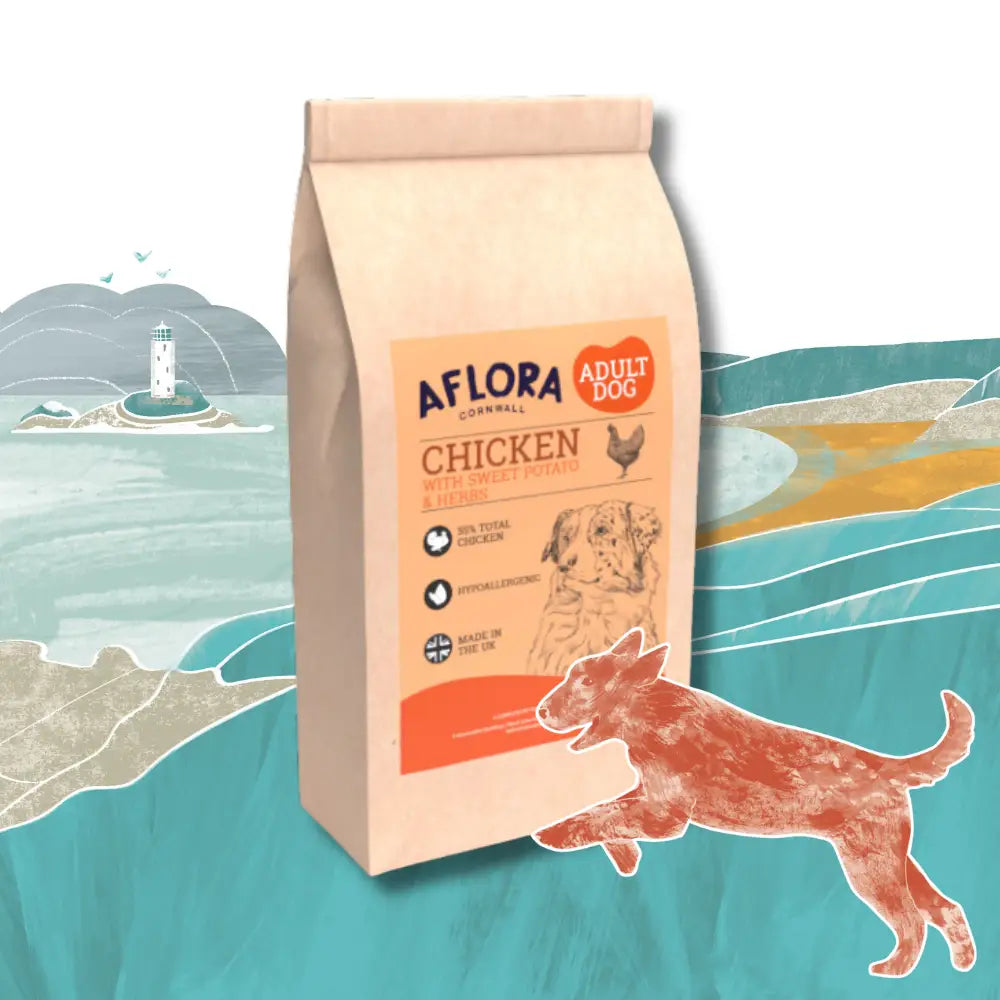
Aflora
Exclusive to The Pets Larder: the same philosophy as Canagan at a more accessible price.
We launched Aflora because Canagan, while excellent, isn't accessible to every household at its price point. The recipe runs at slightly lower meat content (60-65%) but follows the same principles: named meat first, varied vegetables, no legume bulking, no fillers. The aim was to put Canagan-quality digestion within reach of more owners. Aflora is named after Flora, my Airedale, and was developed based on what I observed across years of running daycare about canine nutrition and digestion.
Key Benefits:
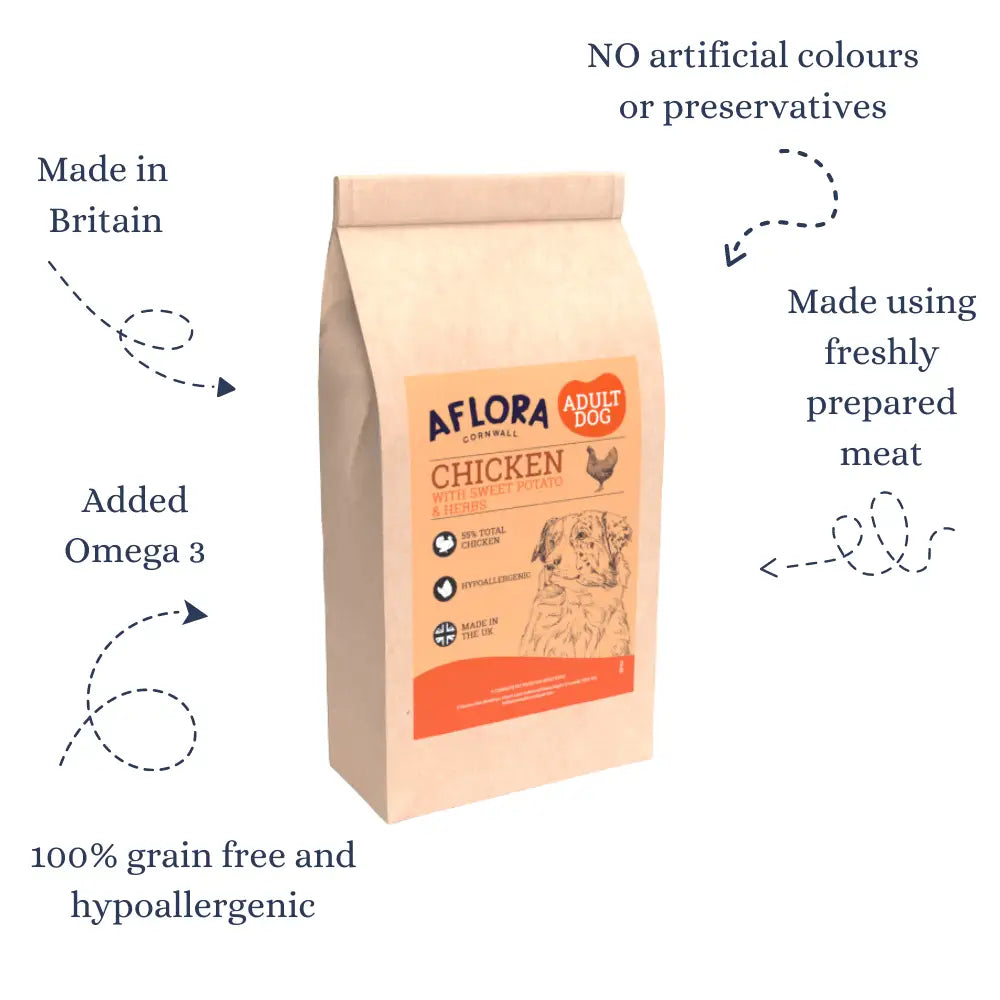
- 50-55% freshly prepared meat
- 100% grain-free and hypoallergenic
- Balanced with vegetables, herbs and essential vitamins
- Carefully formulated for everyday adult nutrition
- Made in the UK to high welfare standards
- Honest pricing with no compromise on quality
- Stool quality consistently 8-9/10 in suitable dogs
Best For: Multi-dog households, owners who want grain-free quality without the highest-tier price.
Tribal Cold-Pressed
The grain-free option for sensitive digestion, gentle on stomachs.
Tribal sits in a different category — cold-pressed rather than extruded grain-free. Cooked at lower temperatures, doesn't swell in the stomach, gentler on dogs with frequent digestive upset. For grain-free dogs specifically, Tribal is the option I reach for when the dog has both grain sensitivities and a sensitive stomach. The trade-off worth knowing: in dogs with very robust digestion, cold-pressed can produce stools that are slightly too firm and crumbly.
Key Benefits:
- 35% fresh meat (no meat meal, ever)
- Cold-pressed for maximum nutrient retention
- Doesn't swell in the stomach — ideal for dogs prone to bloat
- Hypoallergenic and gentle on sensitive tummies
- EU-made, with sustainably sourced fish (MSC certified)
- Joint care including glucosamine and green-lipped mussel
- Most consistent digestive stabiliser I've watched
Best For: Dogs with grain sensitivities AND sensitive digestion, dogs recovering from gut issues who need a stable grain-free option.
Lily's Kitchen Grain Free
Wet food alternative for grain-free feeding, ideal for older or fussy dogs.
Sometimes a dog needs grain-free wet rather than dry — older dogs, fussy eaters, dogs who don't drink enough water. Lily's Kitchen's grain-free wet recipes are well-formulated with named proteins and clean ingredient lists. The brand has been a UK natural pet food fixture for over a decade, and their grain-free range maintains the same quality standards as their wider catalogue.
Key Benefits:
- Named meat sources, varies by recipe
- 100% grain-free across the range
- Higher moisture content (better for hydration)
- No artificial colours, flavours or preservatives
- UK-made by an established natural brand
- Wide recipe range across life stages
- Stool quality typically 8-9/10 in suitable dogs
Best For: Senior dogs, fussy eaters, owners who want grain-free wet food, dogs who benefit from higher moisture intake.
Forthglade Grain Free
Accessible grain-free wet, widely available across the UK.
Forthglade has done a lot to make grain-free feeding accessible to more UK households. Their grain-free wet trays are widely available and produce reasonable digestion outcomes for most dogs. Not as nutritionally dense as Lily's, but a sensible mid-tier option for owners new to grain-free feeding who want a recognisable brand at reasonable pricing.
Key Benefits:
- Named meat as primary ingredient
- 100% grain-free across the range
- No artificial additives, colours or flavours
- Affordable mid-tier pricing
- Widely stocked across the UK
- Long-established Devon-based natural brand
- Good gateway product for grain-free transitions
Best For: Owners new to grain-free who want a recognisable brand at accessible pricing.
What to Look For in a Quality Grain-Free Food
The same principles that apply to any quality dog food, with grain-free-specific additions:
- Named meat first, ideally 50%+ — "freshly prepared chicken" or "deboned salmon" beats "chicken meal" or "meat derivatives"
- Varied vegetables, not legume-dominant — sweet potato, carrots, spinach, parsley, herbs, modest pea content is fine; pea protein isolate as the second or third ingredient is not
- No artificial additives — preservatives, colours, flavours
- Clear allergen declarations — quality grain-free brands state clearly which proteins are excluded
- Appropriate fat content — too high causes loose stools, too low affects coat condition
The Brands I Approach with More Caution
Not all grain-free is equal. Some grain-free brands lean heavily on peas, lentils, and potatoes to bulk out the recipe — exactly the formulation pattern the FDA flagged. I won't name specific brands here because formulations change, but the principle is consistent:
Read the first ten ingredients. If named meat sources dominate the first five, you're probably looking at a quality formulation. If peas, pea protein, lentils, or potato appear in the first five — and especially if they appear multiple times — that's the legume-heavy pattern worth being cautious about.
The reformulation that's happened across the industry since 2018-2019 has been substantial. Many brands that were legume-heavy then have moved toward more varied vegetable profiles. But not all of them. Check the label.
Comparison Table
| Brand | Format | Meat Content | Price per Day* | Best For |
|---|---|---|---|---|
| Canagan | Dry kibble | 60% | £1.02 | Benchmark grain-free, first transitions |
| Aflora | Dry kibble | 50-55% | £0.83 | Same philosophy, more accessible price |
| Tribal | Cold-pressed | 45% fresh | £1.41 | Grain-free for sensitive digestion |
| Lily's Kitchen | Wet trays | Varies by recipe | £1.40 | Wet feeding, fussy eaters |
| Forthglade | Wet trays | Varies by recipe | £1.10 | Accessible wet grain-free |
Approximate cost based on average adult dog portion. Visit each product page for current pricing and pack options.
How to Transition to Grain-Free
The standard 7-10 day transition applies, with one specific note for grain-free.
- Days 1-2: 25% new, 75% existing
- Days 3-4: 50/50
- Days 5-6: 75% new
- Day 7+: 100% new
For dogs with confirmed grain sensitivities, the first 2-3 weeks may show some adjustment as the body clears the inflammatory load — a brief period of looser stools, slight coat dandruff, or temporary itchiness is not uncommon and usually resolves. Skin and ear improvements typically take 6-8 weeks to fully manifest.
If stools haven't settled to 8/10 or above after 4 weeks on a properly transitioned grain-free food, the specific recipe may not suit the dog. Try a different protein within the same brand, or move to a different brand entirely.
What I'm Confident About After Twelve Years
After watching enough dogs eat across every formulation imaginable, here's what I'd say with confidence about grain-free:
- Dogs aren't cake eaters. Their bowls should never be primarily grain.
- Grain in small ratios — a morsel of toast, a treat occasionally — is fine for most dogs.
- Removing grain entirely benefits dogs with confirmed sensitivities and is an excellent option for any healthy dog whose owner wants to feed closer to evolutionary diet.
- The dogs that benefit most from grain-free are those with skin, ear, coat, or digestive issues that haven't resolved on grain-inclusive food.
- The DCM concerns are real but manageable — choose formulations that aren't legume-heavy and the risk profile is reasonable.
- Stool quality is the most reliable indicator of whether the food is working.
- Canagan remains my benchmark; Aflora is the same philosophy at a more accessible price.
- Cold-pressed grain-free (Tribal) earns its place for sensitive digestion specifically.
- Ratios matter more than absolutes.
What Good Grain-Inclusive Food Looks Like
Grain-free isn't the only legitimate way to feed a dog well. Quality grain-inclusive feeding can be excellent for the right dog — and saying so reinforces the actual thesis of this guide, which is about formulation quality rather than ingredient ideology.
A good grain-inclusive food looks like this:
- Named meat as the first ingredient (50%+ where possible)
- Modest oats or brown rice rather than wheat or maize
- Varied vegetables and herbs rather than legume-heavy bulking
- No "meat and animal derivatives" — proteins clearly identified
- No artificial colours, flavours, or preservatives
- Appropriate fat content for the dog's energy needs
If you're feeding a quality grain-inclusive food and your dog is producing 9-10/10 stools with a shiny coat, healthy ears, and stable energy, there is no reason to switch. The problem isn't grain — it's grain dominating a bowl that should be meat-led.
The real distinction worth making isn't grain-free versus grain-inclusive. It's quality formulation versus poor formulation. A well-made grain-inclusive food is genuinely better than a poorly made grain-free one. Always look at the ingredient list, not just the marketing on the front of the bag.
What I'd Avoid
- Foods where wheat, maize, or rice appear in the first three ingredients, with vague meat references later down — the genuine cake-eater bowls
- Grain-free formulations where peas, lentils, or potatoes dominate the first five ingredients
- "Grain-free" marketing on otherwise low-quality foods (the absence of grain doesn't make a poorly formulated food good)
- Switching to grain-free without a clear reason if your dog is genuinely thriving on quality grain-inclusive food
- Persisting with any food, grain-free or otherwise, that's producing 6/10 or worse stools after 4-6 weeks
Final Thoughts: The Best Grain-Free Dog Food 2026
If your dog has a clear reason to go grain-free — confirmed sensitivities, recurring skin or ear issues, persistently loose stools — properly formulated grain-free can be transformative. The brands below are the ones I'd put my own dogs on.
✅ Canagan — the benchmark for grain-free done properly ✅ Aflora — the same philosophy at a more accessible price ✅ Tribal — cold-pressed gentleness for sensitive digestion ✅ Lily's Kitchen — wet feeding for older or fussy dogs ✅ Forthglade — accessible mid-tier grain-free wet
Whichever you choose, remember the principle: ratios matter more than absolutes. Dogs aren't cake eaters. Their bowls should be meat-led, with grain in small ratios — or none at all if it suits them better.
✅ Named meat first, varied vegetables ✅ Not legume-dominant ✅ Properly transitioned ✅ Matched to your dog's actual needs ✅ Fed in ratios that respect what dogs evolved to eat
➡️ Browse our full grain-free dog food range, or get in touch if you'd like help working out which approach might suit your dog.
Written by Katy Peck, founder of The Pets Larder. Katy founded Doggy Day Care Cornwall in 2014, building it from her back garden with three dogs to a peak capacity of 80 dogs daily across four years before opening The Pets Larder in 2018. She launched the Aflora range based on what she had observed in those years about canine nutrition, digestion, and what dogs actually thrive on. The Pets Larder won Independent Pet Shop of the Year (PetQuip & PIF) in 2021.


