


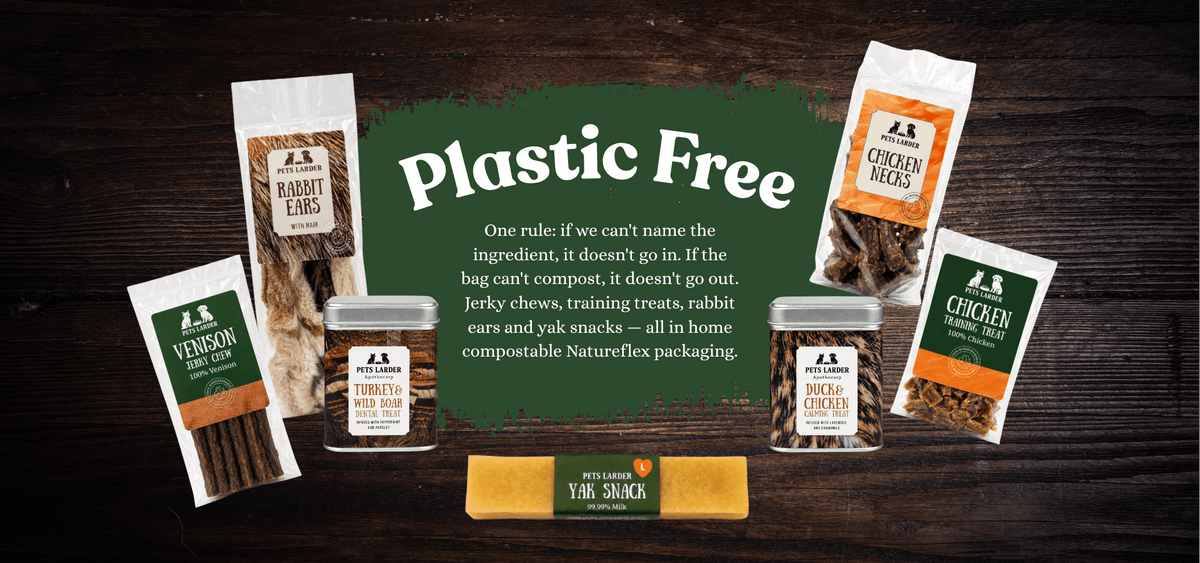
"Compostable", "biodegradable" and "recyclable" don't mean the same thing — and none of them should be taken at face value without asking what is being claimed, under what conditions, and what happens at the end of life. Certified compostability gives you a defined test standard, but industrial and home compostability are very different things. "Biodegradable" on its own tells you much less unless the conditions and timeframe are clear. "Recyclable" doesn't necessarily mean your local council accepts the packaging. Our Plastic Free Pets range uses certified home-compostable packaging on the products where the technology allows it. Some products it doesn't allow yet.
The packaging industry has spent five years perfecting the visual language of green credentials — leaf motifs, kraft-brown palettes, hand-drawn typography — without necessarily improving the packaging behind it. The Advertising Standards Authority has been increasingly focused on this gap. Its 2025 rulings included cases where products marketed as "compostable" turned out to be certified for industrial composting only, but the packaging design gave consumers the impression they could compost the packs at home.
The way to read an eco-packaging claim in 2026 is not to trust the front-of-pack imagery. It is to ask five questions of any claim before accepting it.
Don't ask "is this packaging eco-friendly" — ask five better questions
The ASA's current guidance on environmental claims makes clear that terms like "compostable", "biodegradable" and "recyclable" need appropriate evidence and qualification according to how consumers are likely to understand them. In practical terms, that means an informed buyer asks five things of any environmental claim on a pack:
- What is it made from? Cellulose-based film, PLA, other bio-polymers, or a conventional plastic marketed with an eco angle? These behave very differently.
- What certification does it have? Which specific standard, which certifying body, and does the certificate cover the actual packaging format or only a component material?
- Where can it actually be disposed of? Home compost, industrial composting facility, council food waste, kerbside recycling, supermarket take-back, or general waste?
- What conditions does it need? Ambient temperature, industrial heat, specific microbial environment, oxygen availability?
- What happens if those conditions aren't available? A "compostable" pack that ends up in general waste behaves differently from one that ends up in an active compost heap.
Most eco-packaging claims answer some of these questions and quietly avoid others. The gaps are usually where the meaningful information sits.
The three main claims and what each actually tells you
Recyclable
A material capable of being recycled through existing recycling infrastructure. The claim carries different weight depending on how it is qualified. The UK's OPRL (On-Pack Recycling Label) scheme is the industry standard for labelling recyclability, and it currently uses binary labels: "Recycle" and "Do Not Recycle". Under the OPRL rules, a "Recycle" label is only permitted where the packaging type is collected by 75% or more of UK local authorities and can be effectively sorted, processed, and used as recyclate. "Do Not Recycle" applies where fewer than 50% of authorities collect the material, or where infrastructure limitations mean it cannot be reliably processed.
Between those thresholds, OPRL uses intermediary labels such as "Check Home Collections", "Recycle At Recycling Point – Check Home Collections", and "Recycle With Large Bags At Large Supermarkets – Don't Recycle At Home". These directional labels are as important as the binary ones because they tell the buyer where the packaging can actually go — not just that it is recyclable in principle.
Most flexible pet food packaging (pouches, treat bags) sits outside the "Recycle" category in the current OPRL scheme. A pack that says "recyclable" without a clear OPRL label — or with a "Do Not Recycle" or "Check Home Collections" label — is telling you something different from one that carries an unqualified "Recycle" mark.
Biodegradable
"Biodegradable" is not, on its own, a useful description of what will happen to packaging after you throw it away. The important questions are where it biodegrades, under what conditions, how long it takes, and what happens as it breaks down. Current ASA guidance is explicit that marketers need evidence for biodegradable claims and that claims can mislead if consumers are left to assume biodegradation will occur in all conditions.
In practice, "biodegradable" on a pet food pack tells you almost nothing unless the pack also specifies the disposal environment and timeframe. Anything organic biodegrades eventually. The question is not whether — it is where, and how long, and what into.
Compostable
"Compostable" is the eco-packaging claim most closely tied to defined test standards, but the standard behind the claim matters enormously. Two certifications matter in the UK:
- EN 13432 / Seedling logo — industrial compostable. Requires 90% degradation within 6 months at 58°C in controlled industrial composting facilities. Certified via TÜV Austria, DIN Certco, or Vinçotte.
- OK Compost Home / TÜV Austria — home compostable. Requires 90% degradation within 12 months at 20-30°C in domestic compost conditions. A different and more demanding test for home-composting conditions, because home compost heaps rarely reach the temperatures required for industrial degradation.
These two are not interchangeable. Industrial compostability does not mean home compostability. This is the misconception the ASA specifically ruled on in 2025 — products advertised as "compostable" that turned out to be certified for industrial facilities most UK households cannot access.
Most UK households do not have industrial composting facilities. Many councils that offer food waste collection specifically exclude compostable packaging because it doesn't reliably degrade in the anaerobic digestion processes used for food waste. Which means an EN 13432 industrial-compostable pack, in the hands of an average UK consumer without access to industrial composting, often has no working disposal route available.
Why home compostable is a more demanding test
The temperature difference is the whole story. Industrial composting reaches 58°C or higher because commercial facilities pile enough organic matter together to generate serious microbial heat. Home compost heaps average 20-30°C in summer and considerably less in winter.
OK Compost Home certification tests packaging under actual domestic composting conditions and requires 90% degradation within 12 months. Only materials that genuinely break down at ambient temperature qualify. The list of materials that meet this bar is short — cellulose-based films (typically wood pulp or plant-derived), certain paper laminates, and a small number of newer bio-polymer developments. Many PLA-based compostable materials are designed for industrial composting conditions and should not be assumed to be home-compostable unless the specific packaging has appropriate home-compostability certification.
For a household that actually composts at home, genuinely certified home-compostable packaging provides an end-of-life route that industrial-compostable packaging does not. That is a meaningful difference and worth understanding before buying on packaging promises.
Plastic Free Pets — what we've tried and what we've learned
Our Plastic Free Pets sub-range is our attempt to move as much of our own-brand packaging as possible to certified home-compostable materials, where the products themselves allow it. It launched three years ago as a specific commercial commitment: our own-brand treats where the packaging technology permits it would be certified home-compostable, and we would state plainly where it didn't yet.
The products in the range use packaging that carries OK Compost Home certification, which means the packaging is designed to break down in a domestic compost heap within twelve months at ambient temperature. Not sent to a specialist facility. Not requiring council collection. Not "biodegradable in principle". Actually compostable in the corner of a garden with an active compost heap.
The packaging costs us materially more than the conventional alternatives we could use. Certification and testing also add cost. We have chosen to absorb some of that difference and pass some of it on rather than pretend the change is cost-neutral. Whether the trade-off makes sense for any individual customer is their decision to make with information.
What we haven't been able to do yet
Not every product in our range is in home-compostable packaging. The honest reasons:
- Wet food and raw products. The barrier and shelf-life requirements for wet, raw, and freeze-dried products are currently beyond what home-compostable films can reliably deliver. The material either loses barrier integrity too quickly (food goes off) or fails compostability testing under actual use conditions. This is an area where the material science is still catching up.
- Very high-fat products. Very high-fat products can create additional barrier and migration challenges for some compostable packaging formats, making shelf-life performance harder to achieve. Where this affects a product, we say so on the packaging.
- Large-format bulk packaging. The economics of compostable films at 5kg+ package sizes are not currently workable at retail price points that make sense for the customer.
Where we can't yet use home-compostable packaging, we say so. Marketing "biodegradable" or "eco-friendly" on packaging that isn't materially better than conventional plastic is the practice this whole category needs to move away from, not one we want to be part of.
How to compost the packaging at home
Home-compostable pet food packaging goes in the same compost heap as vegetable peelings, garden waste, coffee grounds, and other domestic organic matter. Practical points:
- Empty the packaging fully before composting — residual food attracts pests
- Tear it into smaller pieces — increases surface area and speeds degradation
- Mix it into the heap rather than layering it on top — needs contact with active microbial layers to break down
- Expect it to take up to twelve months — home compost is slower than industrial. The certification standard allows for a full year
- Do not put compostable packaging in your council food-waste collection unless your council specifically says it accepts that packaging. Many UK food-waste systems are designed for food waste rather than packaging, and acceptance varies between local authorities
- Don't put it in kerbside recycling — it isn't recyclable and can contaminate genuine recycling streams
If you don't have access to home composting, the packaging's home-compostability benefit may not be realised. Follow the disposal instructions provided for the specific packaging rather than assuming that "compostable" means it will break down wherever it is thrown away.
What we look for when we source packaging
Because the category is full of misleading claims, we work through the same set of checks on any packaging supplier we consider:
- Certification, not claims. Where a supplier makes a compostability claim, we want to see recognised certification and a valid certificate that applies to the actual packaging format.
- Full material declaration. What the film is made from, cellulose source, adhesive types, printing inks. Everything on the packaging needs to compost, or the packaging isn't compostable in practice.
- Independent testing data for the specific packaging format, not for the base material in isolation. A film that composts as a flat sheet doesn't necessarily compost as a printed, laminated, sealed pouch.
- Barrier performance that supports realistic shelf life for the product. A compostable pouch that halves the product's shelf life creates more waste than it saves.
- Manufacturing supply chain traceability — where the film is made, under what conditions, and whether the manufacturer holds its own certification.
FAQ
What natural dog treats come in compostable packaging? Our Plastic Free Pets sub-range uses OK Compost Home certified packaging on the products where the technology permits it — currently including our air-dried single-ingredient treats and several treat formats where barrier requirements can be met by home-compostable films. The full list is in the collection.
What's the difference between biodegradable and compostable? "Biodegradable" on its own does not tell the buyer what conditions or timeframe are involved. "Compostable" is tied to defined test standards — EN 13432 for industrial composting, OK Compost Home for domestic composting — that specify degradation timeframes at specific temperatures. Certified compostability is materially more informative than an unqualified biodegradable claim.
Can I put compostable pet food packaging in my council food waste bin? Only if your council specifically says it accepts that type of packaging. Many UK food-waste collection systems are designed for food waste rather than packaging, and acceptance varies between local authorities. Check your specific council's guidance before assuming.
Is home-compostable better than industrial compostable? For a household that actually composts at home, home-compostable packaging provides an end-of-life route that industrial-compostable packaging does not, because most UK households cannot access industrial composting facilities. Home compostability is a different and more demanding test because it requires the material to degrade at ambient temperature.
Why does compostable dog treat packaging cost more? The raw materials (cellulose-based films, plant-derived polymers) cost more per square metre than conventional plastic films. Certification adds cost. Compostable films typically have shorter shelf life, which increases stock rotation cost. Our specific experience is that the packaging costs us materially more than the conventional alternatives we could use.
What about "recyclable" pet food packaging? The OPRL scheme's binary labels ("Recycle" / "Do Not Recycle") plus specialist labels like "Check Home Collections" tell you whether the packaging can actually go in your household recycling. Most flexible pet food packaging (pouches, treat bags) sits outside the "Recycle" category in the current OPRL scheme. A pack that says "recyclable" without a clear OPRL label may mean recyclable in principle rather than accepted in practice.
Should I switch entirely to brands with compostable packaging? Only if the underlying product is right for your dog. Packaging is one input into a purchase decision, not the whole decision. A dog food with excellent packaging and poor ingredients is not a better choice than a dog food with good ingredients and conventional packaging. Both factors matter; neither is a substitute for the other.
Where to go from here
If sustainable packaging matters to you, browse our Plastic Free Pets range for the current list of products in certified home-compostable packaging. For a broader view of the treats and chews we stock, see our natural dog treats collection or the best natural dog treats guide.
The packaging industry is slowly getting better at this. It has not got there yet. The pace of improvement depends partly on customer willingness to reward brands that are actually doing the work rather than the ones with the leafier fonts.
References
- Advertising Standards Authority (ASA). Environmental claims: Biodegradable and compostable. CAP/BCAP advice, updated 15 September 2026. asa.org.uk/advice-online/environmental-claims-biodegradable-and-compostable.html
- Advertising Standards Authority (ASA). Misleading environmental claims and social responsibility in advertising.
- GOV.UK. Making environmental claims on goods and services. Green Claims Code guidance from the Department for Environment, Food and Rural Affairs.
- TÜV Austria. OK Compost Home certification scheme standard. Home compostability testing to ambient temperature domestic conditions.
- British Standards Institution (BSI). BS EN 13432:2000 — Packaging. Requirements for packaging recoverable through composting and biodegradation.
- OPRL (On-Pack Recycling Label). How our labels work — current UK recycling labelling scheme. Available at oprl.org.uk
- DEFRA (2023). Environment Act 2021: producer responsibility for packaging. UK government guidance on packaging waste regulation and Extended Producer Responsibility (pEPR).
- European Bioplastics. Certification schemes for compostable bioplastics — comparative summary.