


Reports and customers have been circulating among independent retailers that Pets at Home is phasing Eukanuba out of its stores. At the time of writing, Pets at Home hasn't confirmed this publicly and its brand pages still list Eukanuba as stocked — so treat this as reported, not official. But the posts have been consistent enough that if Eukanuba is what you feed, it's sensible to have a plan.
We don't stock Eukanuba and we're not going to try to be the shop that sells you the closest mainstream substitute. What we can do is help you think about the switch clearly — which is the more useful thing anyway.
If you're going to change food, use the opportunity to look at what you actually want in a bag, rather than defaulting to whatever occupies the nearest shelf space.
What Eukanuba actually is
Eukanuba was founded in the US in 1969 by Paul Iams and has been one of the mainstream premium dry food brands in the UK for decades. European product is manufactured in Coevorden, in the Netherlands.
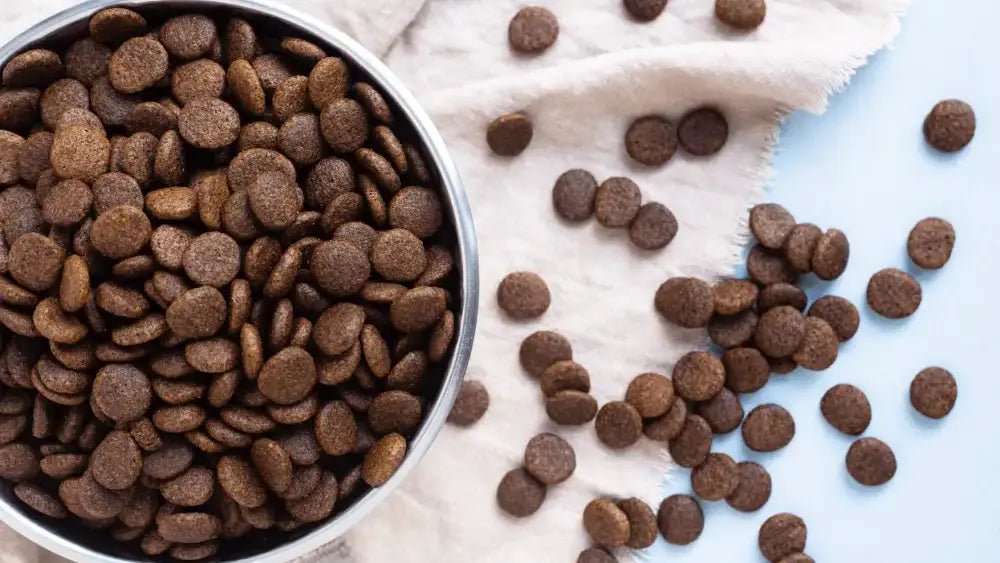
The range is grain-inclusive, sold by breed-size and life-stage — small, medium, large, extra-large, puppy, adult, senior — with a formulation philosophy built around animal protein plus cereals and beet pulp. Chicken or lamb tends to lead the ingredient panel. Adult recipes typically declare in the region of 23–40% protein, depending on the formula.
That's the shape of the food. When people look for a replacement, those are the traits they're usually trying to preserve: a specific life-stage or breed-size formula, a familiar 12kg-ish bag, a mid-premium price point, and a food their dog has done well on.
One important exception. If your dog is on Eukanuba because your vet prescribed a specific formula — the Veterinary Diets range covers conditions like renal, gastrointestinal or weight management — don't treat a retail food as interchangeable. Speak to your vet before switching.
What to look at when you're switching
Four things matter more than the brand name on the bag.
Named meat, not "meat and animal derivatives." An ingredient list that reads "chicken meal (25%)" tells you what's in the food. A list that reads "meat and animal derivatives (12%, of which chicken 4%)" tells you the manufacturer is legally allowed to swap the meat source between batches. Both are perfectly legal. If your dog has a sensitivity, an ingredient panel you can actually read is a lot more useful than one you can't.
A meat percentage you can find. Better foods declare total meat inclusion clearly, usually on the front of the pack. If you have to hunt for it, or it's expressed as "with chicken" with no number, that's telling you something.
Grain-inclusive or grain-free — a choice, not a default. Grain-free isn't automatically better. Some dogs thrive on properly formulated grain-inclusive food. What matters is that the grain (or the grain-free carbohydrate source) is doing a job you're happy with. Rice, oats and ancient grains behave very differently from wheat and maize.
Where it's made. UK-manufactured food is easier to trace, faster to reach you if something goes wrong, and less exposed to shipping disruption. Not everyone will weight this the same way, but it's worth knowing.
If you want a shortcut, our Decode Your Label tool walks you through reading a pet food ingredient panel in about two minutes.
What is the best Eukanuba alternative?
There isn't one. The right replacement depends on what you liked about Eukanuba in the first place — the price, the kibble format, the life-stage or breed-size options, the protein level, the availability, or simply the fact that your dog did well on it. There are broadly three directions you can go.
Similar price, similar format, better ingredients. This is the sideways move most Eukanuba feeders end up making. You're looking for a mid-premium British kibble in a large bag, with clearly declared meat content and no "animal derivatives." Brands like Arden Grange, Skinner's Field & Trial and Burns sit in this space at supermarket-adjacent pricing. Our own Aflora range range is in the same ballpark on price with a higher meat inclusion.
An upgrade, without doubling the cost. If you've been paying £40-plus for a 12kg bag of Eukanuba, you're not far off proper high-meat food. Foods with 60–70% meat inclusion — Canagan, Millies Wolfheart, Wainwright's Trays' higher-end lines, our own Superfood 65 — cost more per kilo but you feed less of them. Cost per day is often closer than the shelf price suggests.
A change of format. If Eukanuba worked and it's stopped working, or you've been thinking about it for a while, this is your moment. Raw, cold-pressed and freeze-dried are all more expensive per kilo than kibble, and all deliver something kibble structurally can't. Not the right answer for everyone; the right answer for some people.
How to switch, if you're switching
Whatever you move to, do it over 7–10 days. Roughly:
- Days 1–3: 75% old food, 25% new
- Days 4–6: 50/50
- Days 7–9: 25% old, 75% new
- Day 10 onwards: new food only
Some dogs handle a straight swap. Others get loose stools for a week. The gradual switch is the low-drama option and it costs you nothing except a bit of planning.
Watch coat condition, stool quality, energy and appetite for the first four to six weeks. That's the window in which a food is either working or not.
Where we'd point you
If you feed Eukanuba currently and want a starting point rather than an essay, our Food Recommender will match your dog's age, size and budget to a shortlist in about a minute. It doesn't only recommend our own brands.
For a longer look at the UK natural dog food market, we keep our best natural dog food UK 2026 guide updated with what's actually worth considering, and why.
If Eukanuba has been working for your dog, there's no need to panic-switch. But if the retail landscape is going to change under you anyway, being clear on what your dog is actually eating — and what your real alternatives are — puts you in a better position than reaching for whatever's left on the shelf.